Why Speed-to-Lead Wins More Jobs for Australian Tradies (And How to Respond in Seconds)
Discover why fast response times win more jobs for Australian tradies and how slow lead follow-up could be costing your business thousands every month.
14 April 2026
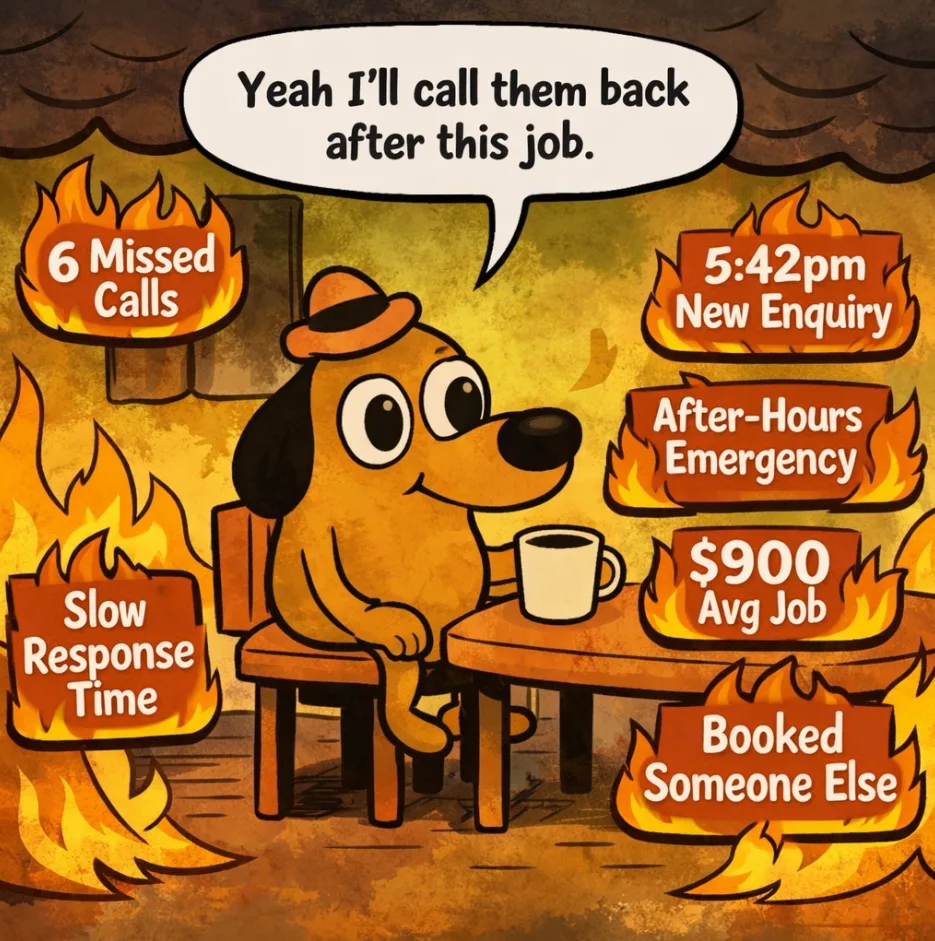
If you are losing jobs to faster competitors, the problem might not be your pricing, your service, or your marketing. It might be your response time. In local service businesses, the first tradie to reply usually gets the first real shot at the job.
The First 5 Minutes Decide Who Gets the Job
At 6:42 PM, your phone rings while you’re driving home from the last job.
You let it ring out.
You tell yourself you’ll call back when you get home.
By 6:47 PM, that same customer has already called two other tradies.
By 6:50 PM, one of them has replied.
By 7:00 PM, the job is booked.
And you never even knew you lost it.
This is how thousands of dollars in work disappear every month for Australian plumbers, electricians, HVAC technicians, landscapers, and local service businesses.
Not because there’s no demand.
Not because your service isn’t good.
But because the lead got to someone faster.
When a customer has no hot water, a blocked drain, a tripped switchboard, or an urgent repair, they are not sitting around waiting for a callback tomorrow morning.
They want a response now.
The problem is most tradies are on the tools, under a house, on a ladder, driving between jobs, or handling after-hours admin when enquiries come in.
Calls get missed.
Quote requests sit unanswered.
Messages pile up until the next day.
And by then, the customer has already moved on.
In local service businesses, speed is not admin. Speed is conversion.
Because the reality is simple:
the first tradie to respond usually wins the job.
Why Customers Buy Fast in Home Services
When someone needs a tradie, they’re rarely making a slow, considered purchase.
This isn’t like shopping for a new TV or comparing gym memberships.
Home services are usually triggered by a problem that needs immediate relief.
A burst pipe isn’t something a homeowner wants to think about overnight.
A house with no hot water becomes urgent the moment someone tries to shower.
A tripped switchboard means lights, appliances, or power may be down.
A broken air conditioner in the middle of an Australian summer quickly moves from inconvenience to emergency.
An emergency lockout turns into pure urgency within minutes.
These are not shopping decisions.
They are immediate relief decisions.
The customer’s mindset is simple:
Who can help me fastest?
That means their decision-making order usually looks like this:
- Fastest reply
- Trust
- Availability
- Price
Price still matters, but it often comes after speed and confidence.
In urgent service situations, the first business that responds and sounds reliable immediately gains the advantage.
The customer isn’t looking for the “perfect” tradie.
They’re looking for the first one who gives them certainty.
A fast reply signals professionalism.
It tells them you’re active, responsive, and available.
A slow reply creates doubt.
They start thinking:
“If they take this long to answer, how long will they take to show up?”
That’s why response time directly shapes trust, conversion, and booked jobs.
In local services, speed isn’t just convenience.
It’s the first proof that you’re the right choice.
The Revenue Cost of Slow Response
Let’s put real numbers on it.
Say your business receives 40 enquiries per month.
That could be:
- phone calls
- website quote requests
- Facebook messages
- SMS enquiries
- missed calls
Now let’s assume just 20% of those leads are lost because the response was too slow.
That’s only 8 enquiries per month.
Not a crazy number.
For most tradies, that’s actually conservative.
Now use an average booked job value of $850.
That means:
8 lost enquiries × $850 = $6,800 in lost revenue every month
That’s not theory.
That’s real money.
Over a full year, that becomes:
$6,800 × 12 = $81,600 per year
Gone.
Not because the work wasn’t available.
Not because your pricing was wrong.
Not because you needed more leads.
Because the response took too long.
This is where most service businesses misdiagnose the problem.
They think they need more marketing.
More ads.
More leads.
More website traffic.
But if response speed is slow, more leads simply means more leakage.
Slow response is not an admin problem. It’s a revenue leak.
Every missed callback, unanswered message, or quote request left until tomorrow morning compounds into lost cash flow.
And the worst part?
Most businesses never track it.
They only see the jobs they win.
They rarely see the jobs that quietly went to the next tradie who replied first.
For a plumbing, electrical, HVAC, or landscaping business, recovering even a fraction of that lost revenue can completely change monthly cash flow.
One extra booked job per week at $850 average value is:
$3,400/month
$40,800/year
That’s why response systems often generate ROI faster than additional lead generation spend.
Because the money is already coming in.
You just need to stop it leaking out.
Why Most Tradies Lose Jobs After 5PM
Here’s where the biggest revenue leak usually happens:
after hours.
Most customers don’t call tradies in the middle of their workday.
They call when their day slows down.
That means enquiries spike during:
- nights
- after-work hours
- weekends
- Sundays
- emergency hours
Think about homeowner behaviour.
They notice the leaking tap after dinner.
The hot water system stops working before the kids’ shower.
The air conditioner dies on a hot Saturday afternoon.
The power trips at 8:30 PM.
The garage door won’t close on Sunday night.
These problems don’t wait for Monday morning.
And neither do customers.
Most people will search for help the moment the issue becomes a problem.
They’ll call the first few businesses they find.
If nobody answers, they move to the next.
By the time you check your phone later that night, or worse, the next morning, the job is often already gone.
This is where small service businesses lose a massive amount of work without even realising it.
Not because the leads weren’t there.
Because the business had no system in place after hours.
The reality is simple:
customers shop for certainty when problems happen outside business hours.
The first business to reply, send a text, or confirm availability immediately feels more professional and more trustworthy.
That speed creates confidence.
And confidence wins jobs.
This is why after-hours lead capture is one of the highest-leverage fixes for tradies.
Read our guide on missed-call recovery for tradies if you want to go deeper into how missed after-hours calls turn into lost revenue, and how to recover them.
The 5-Minute Rule: Why Speed Changes Conversion
There’s a simple rule in lead conversion that most service businesses underestimate:
the first five minutes matter most.
Once a customer submits a quote request, makes a call, or sends a message, their intent is at its highest.
This is what sales teams call lead temperature.
And it drops fast.
Leads contacted within the first few minutes convert dramatically better than leads contacted later.
The longer the delay, the lower the chance of making contact, building trust, and booking the job.
This matters even more in home services.
A customer with a leaking pipe, no power, or broken air con is not filling out one form and waiting patiently.
They are actively looking for the first available tradie.
That means every minute of delay gives your competitor a better chance to step in first.
Think about the conversion timeline:
- 0–5 minutes: highest intent, highest trust potential
- 5–30 minutes: still warm, but the customer may already be calling others
- 30–60 minutes: lead temperature drops sharply
- Next day: often lost completely
By the next morning, many customers have already solved the problem elsewhere.
This is why response speed has such a direct impact on booked work.
It’s not just about being fast.
It’s about catching the customer while the problem is still urgent and while they’re still choosing.
Fast response creates momentum.
It shows reliability.
It signals that your business is active and responsive.
A delayed reply creates hesitation.
Customers start questioning whether you’ll be hard to deal with later.
That’s why the 5-minute rule isn’t just a sales principle.
For tradies, it’s a direct revenue principle.
The faster the first response, the higher the probability of winning the job.
Why This Happens to Good Tradies
Here’s the important part:
this is not happening because you’re bad at business.
It’s happening because most tradies are forced to wear every hat at once.
You’re not just doing the work.
You’re also:
- quoting new jobs
- chasing invoices
- on site all day
- running staff or subcontractors
- driving between jobs
- ordering materials
- handling customer callbacks
- managing admin after hours
That creates operational bottlenecks.
The phone rings while you’re under a sink.
A quote request comes through while you’re halfway through an install.
A missed call sits unanswered because you’re driving to the next suburb.
A customer texts on Sunday night while you’re trying to switch off.
None of this means you’re disorganised.
It means the business is growing beyond what one person can manually manage.
This is where many owner-operators hit the same ceiling.
More leads start coming in.
More referrals.
More website enquiries.
More repeat customers.
But the lead handling process stays manual.
At that point, growth starts creating friction instead of revenue.
Leads slip through.
Callbacks get delayed.
Quote follow-ups happen late.
And jobs quietly go to faster competitors.
The issue isn’t effort.
The issue is bandwidth.
There are only so many calls, messages, and follow-ups one person can physically handle while also delivering quality work on site.
That’s why the problem is rarely work ethic.
It’s usually a capacity problem inside the business system.
How Synergy Labs Fixes the Speed-to-Lead Problem
Once you realise the issue is a capacity bottleneck, the fix becomes simple:
remove manual response from the critical first five minutes.
This is exactly what the Synergy Labs AI Front Desk System is built to do.
Instead of relying on you to catch every call, text, or quote request while you’re on site, the system responds instantly.
The moment a lead comes in, whether it’s a missed call, website form, SMS, or after-hours enquiry, the front desk system activates automatically.
Instant first response
Within seconds, the customer receives a reply.
“Hi, thanks for reaching out. We’re currently on a job right now. What can we help you with?”
That immediate response keeps the lead warm and stops them moving straight to the next tradie.
Lead qualification
Instead of back-and-forth admin, the system collects the key details upfront:
- suburb or service area
- issue type
- urgency
- preferred booking time
- photos if needed
- callback preference
By the time you review the lead, it’s already structured and quote-ready.
Booking and callback workflow
Once qualified, the lead can move directly into:
- calendar booking
- callback queue
- CRM pipeline
- staff dispatch workflow
That means no sticky notes, no forgotten voicemails, and no leads buried in your text messages.
After-hours coverage
This is where the system creates the biggest ROI.
Instead of losing jobs at night, on weekends, or Sundays, the front desk keeps responding when you’re unavailable.
That means your business stays active even when you’re off the tools.
The result is simple:
- faster first response
- higher trust
- more booked jobs
- less admin pressure
This isn’t about “AI.”
It’s about installing a system that protects revenue during the exact moments most tradies lose it.
What Just 3 Recovered Jobs Per Month Is Worth
Let’s keep this simple.
Say your average job value is $900.
That could be:
- plumbing call-outs
- electrical fault repairs
- HVAC servicing
- emergency weekend work
- small installation jobs
Now imagine the front desk system helps you recover just 3 extra jobs per month that would have otherwise gone cold.
That’s not a massive number.
In most businesses, that’s completely realistic.
Now do the maths:
3 jobs × $900 = $2,700 extra revenue per month
Annualised, that becomes:
$2,700 × 12 = $32,400 per year
And that’s from only three recovered jobs per month.
Now imagine it’s 5.
That becomes:
$4,500/month
$54,000/year
This is why speed-to-lead systems often outperform additional ad spend.
The leads are already there.
The demand already exists.
The issue is response friction.
When you reduce that friction, more existing leads convert into booked work.
That means the return isn’t created by more marketing.
It’s created by recovering revenue already flowing into the business.
For most tradies, the system doesn’t need to recover dozens of jobs to pay for itself.
Often, one extra booked job per month covers the cost.
Everything after that is pure upside.
That’s the leverage of fixing response time instead of just buying more leads.
Stop Losing Jobs to Slow Response
The reality is simple.
The leads are already coming in.
The problem is they’re being lost in the gap between enquiry and response.
A missed call at 7:15 PM.
A website quote request left until the next morning.
A Sunday message that never gets answered.
That’s not just admin delay.
That’s booked revenue going to the next tradie who replied first.
In local service businesses, speed builds trust.
And trust wins jobs.
The businesses growing fastest are not always the best marketers.
They’re the ones with better systems.
They remove bottlenecks.
They respond faster.
They capture more jobs from the same lead flow.
That’s exactly what the Synergy Labs AI Front Desk System is designed to solve.
It helps tradies and local service businesses:
- respond in seconds
- recover missed calls
- qualify leads automatically
- book jobs faster
- reduce admin pressure
- protect after-hours revenue
If your phone, inbox, and callback list are already costing you work, the solution isn’t more leads.
It’s a better response system.
Book a strategy call with Synergy Labs and we’ll show you how to install a front desk system that turns missed opportunities into booked jobs.